CRI & R9 Explained: The Guide to LED Color Quality for Retail & Museum Lighting
Color quality is the single most-negotiated spec in retail and museum lighting — and the one most frequently misunderstood. "CRI 90" is quoted on a thousand cheap fixtures; few buyers can say what that number actually measures, and nearly none can say what the spec sheet omits: R9. This guide explains CRI from its measurement principle, why red rendering is the part that separates a $2 fixture from a $200 one, how the 80/90/95 tiers are perceived in practice, and how to read a spec sheet without being fooled by it.
What CRI Actually Measures
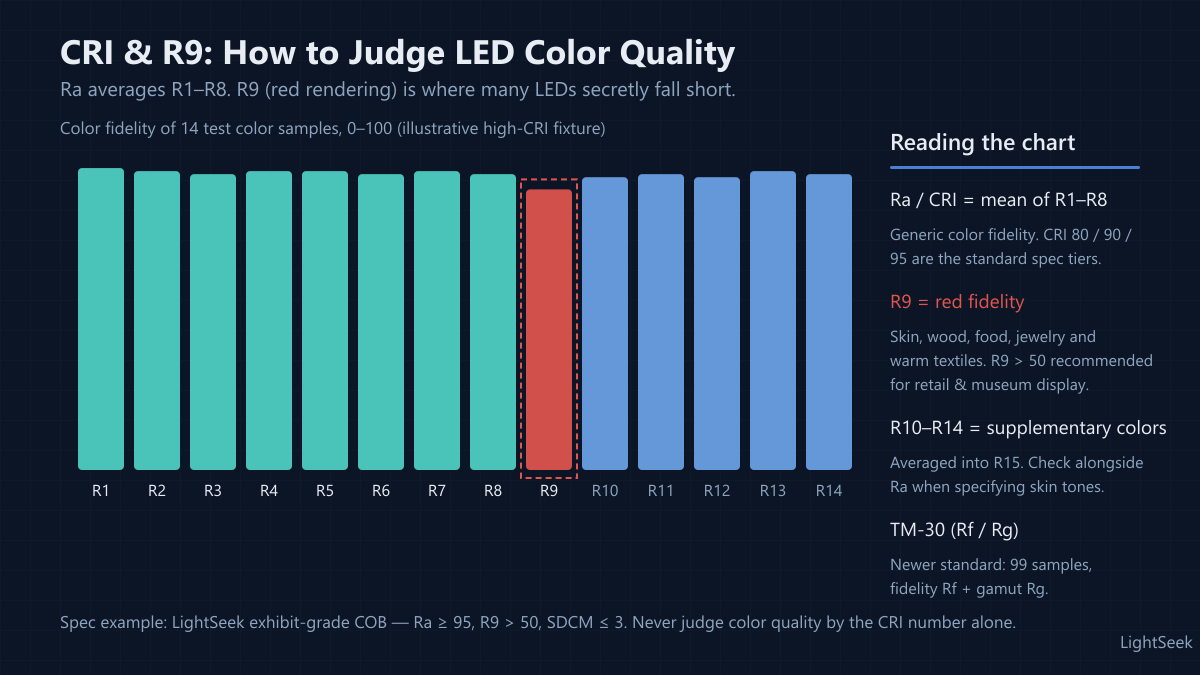
Color Rendering Index (Ra) is a 0–100 score defined in CIE 13.3: it compares how a light source renders a set of 14 test color samples against a reference illuminant of the same correlated color temperature. The index you see quoted — "CRI 90" — is conventionally the mean of the first eight samples (R1–R8):
- R1–R8 — pastel/muted colors (desaturated hues, e.g., light grayish red, yellow-green). Averaged into Ra.
- R9–R12 — saturated colors: R9 is strong red, R10 yellow, R11 green, R12 blue.
- R13–R14 — skin tone (light yellowish flesh) and leaf green.
- R15 — mean of R9–R14, sometimes quoted as "extended CRI".
Why R9 Is the Number Nobody Puts On the Box
White LEDs are physically a blue die plus a yellow phosphor. Producing white is easy; producing white in which deep red still renders correctly is hard — it demands red-emitting phosphor components that lower overall efficacy. That cost-pressure is exactly why R9 is where crimping happens: a fixture can score Ra 92 (pastels average high) while saturated reds render dull, brownish, or dead flat.
In application terms, low R9 shows up as:
- Flesh tones losing warmth (the classic "pale ghost" look on faces in a fitting room)
- Wood and leather looking plasticky; red wine, flowers and produce losing depth
- Jewelry and gold looking wrong — metals reflect their surroundings, and the ruby is what betrays the lighting
CRI 80 vs 90 vs 95: What You Actually See
| Tier | What it looks like | Where it passes |
|---|---|---|
| Ra 80 | Perfectly acceptable in most rooms; colors slightly muted and coolish in whites | Warehouse, corridor, utility, offices (with glare control) |
| Ra 90 | Good color saturation; skin tones acceptable; metals and textiles clearly improved | General retail, hospitality, showrooms |
| Ra 95+ (with R9>50) | Museum-grade: wooden joinery, paintings, leather and skin read as in daylight — saturated reds stay true | Jewelry, fashion flagship, museum/gallery, luxury hospitality |
Important caveat: CRI alone cannot be ranked linearly. Outside pastel samples, two different Ra 90 fixtures may render saturated red differently. Always ask for R9 and, increasingly, TM-30 (Rf fidelity + Rg gamut) where specifiers require it: TM-30 uses 99 samples and is the modern standard for judging real-world color rendition.
What Retail Lighting Requires
- General retail: Ra≥90, R9≥50 on display zones. CCT 3500–4000K neutral (fashion) to 4000–5000K for jewelry/cosmetics.
- Color continuity matters as much as the index: SDCM ≤3 across fixtures, or a single shelf will show banding of color between adjacent heads.
- Contrast, not just fidelity: accent 3–5x ambient. Our illuminance calculator helps set the ratio quickly.
What Museum and Gallery Lighting Requires
Museums run the strictest regime, and the requirements go beyond CRI:
- Ra≥95 and R9>50, SDCM ≤3 — color must be faithful for catalog photography and curators across years.
- Low UV and IR: LED sources emit negligible UV/IR at the beam compared to halogen, which is why LED track replaced halogens in conservation lighting. Peak-blue components still matter; specify specialty museum UV/IR cut modules where pigment research demands.
- Lux limits for conservation (e.g., ~50 lux for textiles and watercolors, 200–300 lux for oil and tempera on canvas). 0.1% DALI dimming lets you set and lock those levels — see our museum track lighting guide.
- Narrow beams (15–24°) with sharp cutoff to prevent light spilling onto adjacent works.
How to Read a Spec Sheet Without Being Fooled
- Look for R9 itself, not "CRI>90". R9>50 is the pass line for display lighting.
- Ask for the SDCM/macAdam bin — ≤3 for premium, ≤5 standard.
- Request an LM-80 report (lumen maintenance) and the Tc / junction temperature — color shifts over life with junction heat.
- Test the fixture before a bulk order: light a real red object, a skin-tone test card and a wooden surface side by side with a reference. The eye catches what the sheet omits.
- Reject "CRI upto 95": "upto" means nothing at the fixture you're buying. Ask for the measured value of the exact model + bin.
LightSeek High-CRI Portfolio
Our exhibit-grade families consistently spec Ra≥95, R9>50, SDCM ≤3, with project-level LM-80 and TM-30 data on request:
- LED track lights — COB spotlights 7–30W with 15°/24°/36°/60° interchangeable optics, and zoomable series for rotating exhibitions
- High-CRI linear LED track — continuous runs, Ra≥90–95
- DALI dimmable 40W museum track light — zoomable, scene-memory, conservation dimming
- High-CRI downlights — recessed and surface for retail and hospitality
Sources & Verification
This guide cites CIE 13.3-1995 (CRI definition and samples), IES TM-30-18 (Rf/Rg color rendition), IES LM-80 (lumen maintenance), and ANSI C78.377 (CCT and binning). CRI tier values are market-common ranges, not laboratory measurements of any single product; product-level R9 and TM-30 data for LightSeek fixture models are available from the sales team with test reports.
Choosing color quality for a specific store or exhibit? Send the application and target CCT — we will shortlist matched fixtures with documented R9. Talk to our team.
FAQ
What is CRI in lighting?
Color Rendering Index (Ra, 0–100) measures how accurately a light source renders 14 test color samples against a reference illuminant of the same color temperature, as defined by CIE 13.3. The commonly quoted single value is the mean of the first eight samples (R1–R8, muted colors). CRI 90+ is standard for commercial display; CRI 95+ for museums.
What is R9 and why does it matter?
R9 is the rendering value for saturated red — the hardest color for warm-white LEDs. It is excluded from the Ra average, so a fixture can quote CRI 92 yet render reds dull. For skin, wood, leather, food, wine and jewelry, specify R9 > 50 explicitly.
Is CRI 95 noticeably better than CRI 90?
Usually yes in display lighting, but not because of the number: the meaningful difference is R9 and color consistency (SDCM). A CRI 95 fixture with R9>50 renders saturated reds, warm skin and wood distinctly better than a CRI 90 fixture with weak R9. Compare R9 always — not only the Ra number.
What CRI do I need for a retail store?
General retail: Ra≥90 with R9>50 on display zones and SDCM ≤3 for consistency between fixtures. Fashion, jewelry and cosmetics: 4000–5000K at Ra≥95 where the product's material color is the selling point. Check the standard — not just the fixture price.
Do LEDs emit UV light — are they safe for paintings?
LEDs emit negligible UV and IR at the beam compared to halogen, which is why they replaced halogen in conservation. For high-value paintings, textiles and works on paper, additionally specify museum UV/IR-cut modules and respect the lux limits (about 50 lux for light-sensitive media, 200–300 lux for canvas works).
What is TM-30 — should I use it instead of CRI?
TM-30 (IES) is the modern color rendition standard: 99 test samples, reporting fidelity Rf (0–100) and gamut Rg. It is more sensitive to saturated colors than CRI. Where specifiers or clients require it, ask both: Ra/R9 for the familiar tiers, Rf/Rg for the verdict.
Why do two fixtures with the same CRI look different?
Because CRI averages only R1–R8 and blends everything into one number. Differences live in R9, in the saturated samples R10–R12, in CCT variations within the same nominal Kelvin, and in SDCM binning. Compare R9, SDCM and TM-30 data, then do a physical sample comparison before bulk order.
How is CRI measured — can I test a fixture myself?
CRI is measured with a photometer in a lab following CIE 13.3 — not by eye or photo. A simple side check works for buying decisions: light a dark-red fabric, a wooden surface and a skin-tone card under the candidate fixture next to a known-good reference. Eye + real objects are still the fastest fraud detector; the lab report is the evidence.