What Is Magnetic Track Lighting? Components, 24V vs 48V & How to Choose
Magnetic track lighting is a low-voltage DC lighting system in which luminaires attach to an energized track rail by magnet instead of mechanical clips — so any fixture can be added, moved, rotated, or removed in seconds, without tools and without switching the circuit off. The whole system runs on safe SELV (Safety Extra Low Voltage) 24V or 48V DC, which also enables the ultra-thin, minimalist profiles that made the category popular in hotels, boutiques, and modern interiors worldwide.
Beyond the plug, the topic is what B2B buyers get wrong most: this is a system, not a fixture. Track, driver, luminaire and voltage must all be specified together. This guide explains each layer, what actually matters on a spec sheet, and how to set expectations for run length, power budget and dimming.
Magnetic Track vs Conventional Track Lighting (Three Core Differences)
The physical look is similar — a rail on the ceiling with spotlights on it — but the engineering is different in three ways that matter in practice:
| Property | Conventional track (200–240V) | Magnetic track (24V/48V DC) |
|---|---|---|
| Fixture attachment | Spring clips / rotating adapters, tool-free but fussy | Permanent-magnet snap-on, single-hand repositioning |
| Track voltage | Mains SELV-independent (LV), installer-grade wiring | 24V/48V SELV, safe to touch; track profile can be 5–25mm |
| Fixture removal while live | Not recommended | Safe at SELV; most modules may be repositioned live |
| System "brain" | Built into each fixture (dimming per fixture) | Often centralized in the driver (On/Off, Zigbee, DALI) |
Cost difference is real but narrowing: magnetic systems still cost more per watt than conventional track, and you trade some maximum wattage per run. In exchange you get flexibility that retail and hospitality owners repeatedly value — displays move, merchandise zones change, and the lighting must follow.
System Anatomy: What You Are Actually Buying
Every magnetic track quotation is made of four layers. Know which part is which before comparing two suppliers:
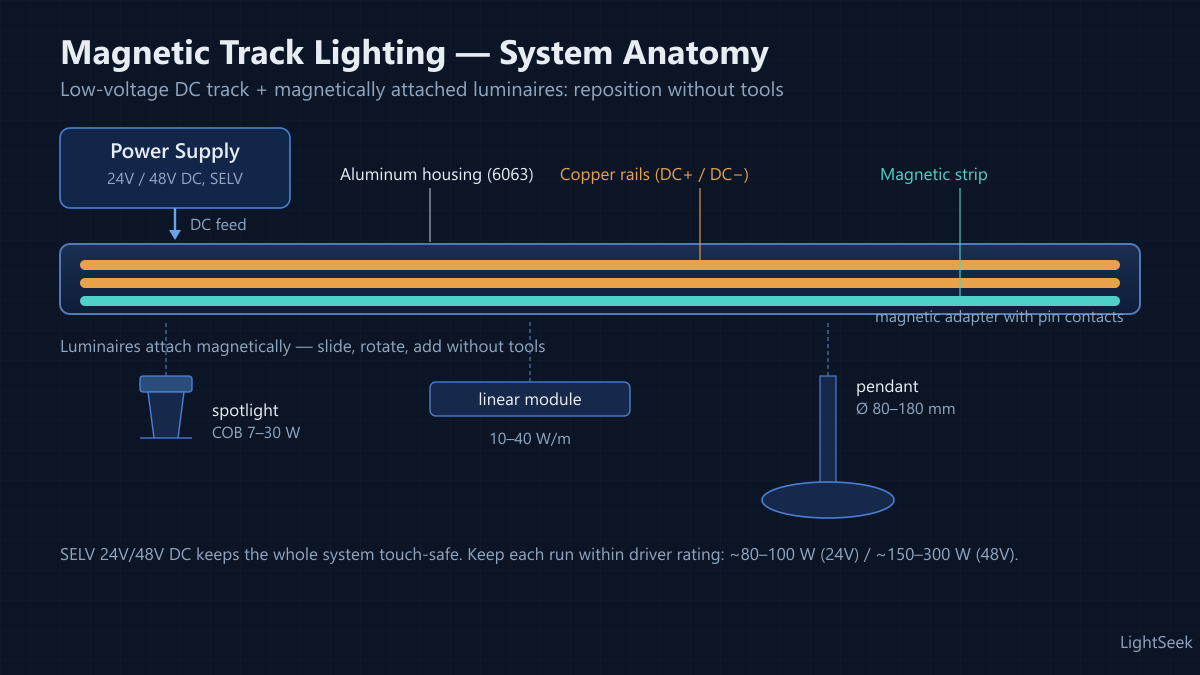
1. Track rail
An extruded 6063 aluminum profile containing permanent magnet strip(s) and two copper conductive rails. Lengths are typically 0.5–3m; L-, T- and cross-connectors join runs. The profile width is the design differentiator: 24V systems reach 5mm (our NANO 5 series), while 48V rails are usually 15–25mm because they carry more current.
2. Driver (power supply)
Converts mains AC into 24V or 48V DC. Everything about dimming behavior — 100%–0.1% or simply on/off — lives here. Choose the protocol at this stage; it cannot be upgraded later without replacing luminaires and drivers.
3. Magnetic luminaires
Spotlight (7–30W), linear module (10–40W/m), pendant, wall washer, ball light — all share one magnetic adapter and one pin-contact electrical interface. That is what makes the system truly modular: mix families freely on one track.
4. Connectors and end caps
Mechanical and electrical integrity depends on these small parts. Poor connectors cause flicker, arcing marks and warranty disputes; ask suppliers what the connector rating is and whether it is insulated.
How the System Works: Low-Voltage DC Made Safe
A nominal 24V/48V DC feed is ELV by definition in EN 60598 and IEC 60417 terms, which is why magnetic tracks can be flash-mounted into furniture, shelving and gypsum without the conduit, earthing and clearance constraints of mains-voltage track. The luminaire adapter has two pin contacts that meet the copper rails; the magnet does the mechanical work, the pins do the electrical work. When you slide a fixture along the rails the whole length stays energized, so a repositioned fixture lights immediately.
Two consequences worth remembering when quoting projects:
- Load is additive. 8 spotlights × 12W = 96W. If the driver supplies 100W, and your client later adds a 30W linear module, the driver is overloaded — protection kicks in (dimming or shutdown). Always specify ≥20% headroom.
- Voltage drops with length and current. At equal power, a 48V system draws half the current of a 24V system, so for the same track and same load the resistive drop is halved. Practical single-feed limits are typically 10–15m for 24V and 20–30m for 48V. See our dedicated 24V vs 48V comparison guide with the physics behind this.
24V vs 48V at a Glance
| Decision factor | 24V system | 48V system |
|---|---|---|
| Typical driver power | 80–100W per run | 150–300W per run |
| Ultra-thin profile | Yes — 5mm possible | 15–25mm |
| Practical single-feed length | ~10–15m | ~20–30m |
| Smart control standard | Zigbee, Bluetooth, Tuya, MiJia | DALI, 0-10V, Zigbee |
| Core markets | Boutique retail, hotels, residences, exhibitions | Commercial retail, office, museum, hospitality |
Rule of thumb: 24V for slim aesthetic + smart-home integration, 48V for power, length and DALI building control.
Where Magnetic Track Systems Win (and Where They Don't)
Sweet spots
- Boutique retail / showrooms — merchandising changes weekly; repoint a linear, swap a 36° zoom for a 15° accent, no electrician.
- Hotels and hospitality — one slim line replaces spot+pendant+wash; the 2700–3000K warm modules keep the ambiance.
- Museums and galleries — CRI≥95, R9>50 modules with DALI 0.1% dimming protect artifacts while achieving exhibit-grade color (see our museum lighting guide).
- Residences — 24V 5mm profiles turn lighting into architecture.
Limits to state up front
- ~80–300W per driver/run — a large ballroom is multiple systems, not one.
- Cost per lumen still exceeds mains track; overkill for pure warehouse or utility lighting.
- Compatibility is locked: track, fixtures and driver must share voltage and protocol, and adapters are not cross-brand standardized — treat the system as one purchase.
What to Check on the Spec Sheet
- CRI / R9 — Ra≥90 for retail; Ra≥95 and R9>50 for exhibits. Check per product family, not per system.
- Dimming protocol — On/Off, Zigbee, DALI or 0-10V; confirm fixture + driver + wall control all speak the same language.
- Wattage per module — sum the planned layout and leave 20% headroom.
- Voltage drop / max run — ask the supplier for its single-feed limit at your load, in writing.
- Certifications — CE/LVD, CB, and for markets: UL/ETL (North America), SAA/RCM (Australia), UKCA (UK).
- Beam angles — if the layout mixes accents and washes, ask whether optics are interchangeable (15°–60°) or fixed.
When you already know the ceiling height, our free beam coverage and illuminance calculators turn beam angles into diameter and lux instantly — useful for the first layout sketch.
Common Misconceptions
- "Magnetic means it will fall off." — Magnets hold steady; rated retention is by design, and fixtures click-lock with pin contact. What fails in cheap systems is the pins and connector, not the magnet.
- "More brightness = better." — Over-lighting with low CRI washes out textiles and food. Contrast ratio plus faithful color matter more than raw lumens.
- "All 24V modules work on any 24V track." — Adapter geometry, polarity and pin spacing differ between systems; mixing brands risks shorting the rail. Buy one family.
- "The driver can be hidden anywhere." — Drivers dissipate heat; closed ceiling voids reduce output and life. Ventilate or over-spec.
Sources & Verification
Terminology and safety classes referenced in this guide follow: EN 60598-1 (luminaires, SELV requirements), IEC 60417-5036 (SELV safety), CIE 13.3-1995 (color rendering), and IEC 62386 (DALI dimming protocol). Run-length and power figures are typical engineering values; product-family specifications, certifications and test reports for LightSeek systems are available on request — see magnetic track systems or contact our engineering team for project-specific data.
FAQ
What is magnetic track lighting?
A low-voltage DC (24V or 48V) lighting system where luminaires attach to the track rail by magnetism: add, move, rotate or remove fixtures in seconds without tools and, at SELV, without switching the circuit off. The track itself is 5–25mm wide, which is why the category is associated with ultra-thin, architectural interiors.
Is magnetic track lighting safe?
Yes. The track runs on 24V or 48V DC, which is Safety Extra Low Voltage (SELV) under EN 60598-1 — safe to touch and compliant for flush mounting into furniture and gypsum. The AC mains connection and driver must still be installed by a qualified electrician.
Can I mix luminaires from different brands on one track?
No — adapter geometry, contact position and polarity are not standardized across systems. Track, luminaires and driver must be purchased as one compatible family; mixing risks poor contact or shorting the rail.
Can the fixture be repositioned while the track is live?
With SELV (24V/48V) magnetic track this is generally safe and is how retail users operate — fixtures click out and back in at full brightness. Mains-voltage track should always be switched off before repositioning.
How much power can one run carry?
Roughly 80–100W per 24V driver/run and 150–300W per 48V driver/run at equal load, plus ≥20% margin. Total wattage of the attached fixtures must not exceed the driver rating or protection will trip.
What is the maximum track length?
Practical single-feed limit is typically 10–15m for 24V and 20–30m for 48V, depending on conductor size and load. Beyond that, use a mid-run power feed or multiple drivers with isolated track sections.
Which controls work with magnetic track lighting?
24V systems commonly offer On/Off, Zigbee 3.0, Bluetooth and Tuya; 48V systems additionally support DALI and 0-10V for building management integration. Decide the protocol at driver selection — retrofitting later means replacing drivers and fixtures.
How does magnetic track compare to conventional track lighting in cost?
Magnetic systems cost more per watt and carry less power per run, but save money elsewhere: tool-free repositioning (no electrician per display change), SELV simplifies installation and permits 5mm profiles that conventional track cannot achieve.