24V vs 48V Magnetic Track Lighting: Voltage Drop, Load & Selection Guide
Every magnetic track project starts with one decision: 24V or 48V? Nobody asks it as a question — buyers inherit whichever voltage their preferred fixture family happens to be — but the choice silently caps power per run, maximum track length, available dimming protocols and even the track's aesthetic thickness. This guide compares both from first principles (current, drop, heat) and ends with a decision tree you can apply to a real project in two minutes.
The Core Difference: Same Watts, Half the Current
Magnetic tracks deliver SELV DC; both systems do the same job from the user's side. The physics differences all trace back to Ohm's law: I = P / V. A 100W load at 24V draws 4.2A; at 48V it draws 2.1A. Lower current means:
- Less resistive voltage drop along the same copper conductor (V = I × R), and
- Less copper needed for the same drop (thinner rails are possible at 24V),
- Less heat in rails and connections (P = I² × R).
That is the entire trade: the current side is consumed by the 24V system's ability to be thin, and by the 48V system's ability to be powerful and long.
Voltage Drop and Maximum Run Length
Voltage drop on a direct-current run is the single most common magnetic-track design error. The end of the track sees the lowest voltage; at low voltage that means dimmer fixtures, color shift, and eventually flicker or driver shutoff. The governing equation for end-loaded worst case:
Vdrop = 2 × I × ρ × L / A (two-way resistance, ρ = 0.0175 Ω·mm²/m for copper, A = conductor cross-section)
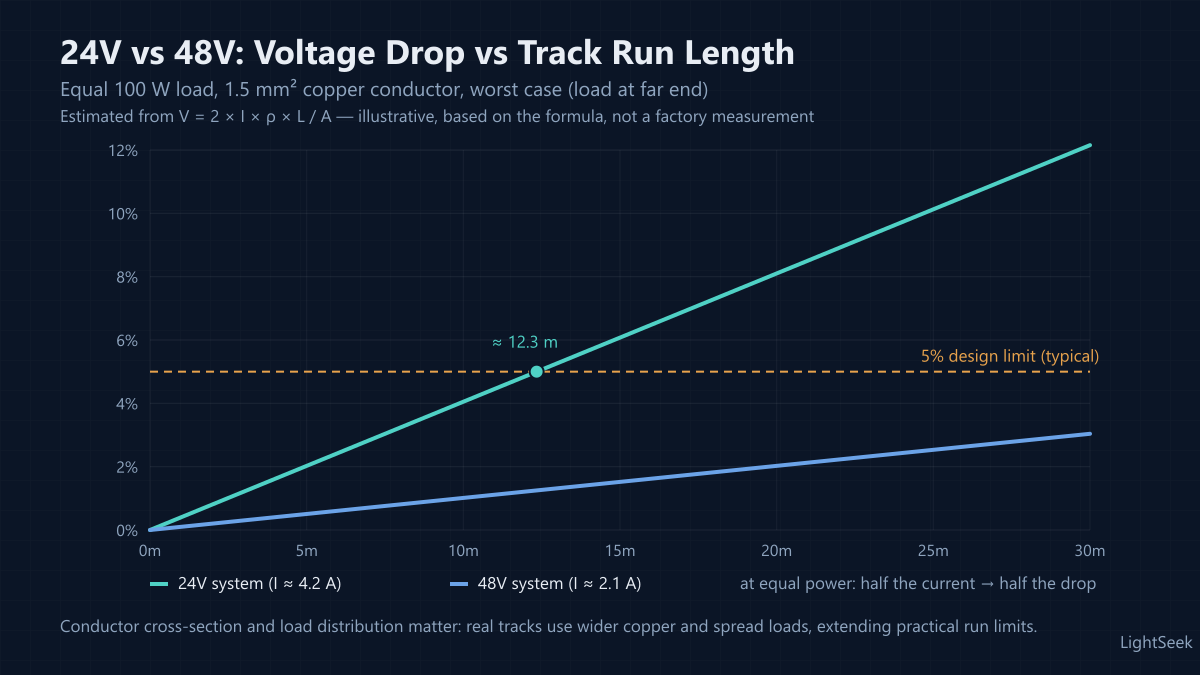
The ≈12m mark is where a 24V run, fully loaded at the far end on a 1.5mm² equivalent conductor, crosses a 5% drop limit — while a 48V run at the same power stays under 3% even at 30m. Two real-world caveats make this better in practice:
- Actual tracks use wider copper and their load is distributed along the rail, not concentrated at the end — so 24V single-feed runs of 10–15m and 48V runs of 20–30m are the typical published limits.
- Consequently, a supplier that quotes only "runs up to 20m" without stating voltage and load has not answered the question — ask for their drop specification at your layout.
LightSeek is running a documented bench test (24V vs 48V, same conductor and load profile) — see the test methodology and publication page. Contact us if you would like the results emailed when released.
Load Capacity: How Many Fixtures Fit on One Run?
| System | Typical driver capacity | Practical fixture count (12W spotlights) | Comment |
|---|---|---|---|
| 24V | 80–100W | 7–8 (leave headroom) | Best with small modules; keep to ≤15m single feed |
| 48V | 150–300W | 12–25 | Supports high-power modules (up to 30W spot, 40W/m linear) |
Always size for the worst case future layout: shops add display zones. 20% headroom on the driver is the minimum; 30% is the smart number. To estimate your own fixture count at a target lux, use our free lighting calculators.
Driver, Safety and Control
- Safety class: both are SELV (EN 60598-1); both may be flush-mounted into furniture and gypsum. The AC side (Class II isolation, earthing of the driver) is where certification discipline shows: look for LVD/CB, UL/ETL or SAA as your market requires.
- Control protocols: 24V families typically ship On/Off, Zigbee 3.0 and Bluetooth/Tuya — home-automation oriented. 48V families add DALI and 0-10V, the two that building management systems and museum scenes expect. Compare protocols, not dimming "standards" words: 0.1% DALI is not the same as 5% leading-edge TRIAC behavior.
- Fail-safe behavior: on voltage out-of-range or over-temperature, quality drivers dim smoothly instead of hard-shutting, with automatic recovery. Ask for the behavior on the data sheet.
Cost: System Price vs Cost of Ownership
| Cost dimension | 24V | 48V |
|---|---|---|
| Track & luminaire unit cost | Higher at the slim end (5mm extrusions cost more) | Comparable or lower per watt |
| Driver cost | Lower | Higher (power + protocol headroom) |
| Installation | SELV simplicity on both — but 24V runs may need more drivers/sections for one big space | Fewer drivers per sqm in large commercial layouts |
| Operating cost | Equal (same LEDs, same efficacy) | Equal |
Decision weight on owning the building: the fixture family cost dominates — pick the products that fit the design, then let voltage follow.
Decision Tree: Which System Should You Specify?
Choose 24V when:
- Design demands a 5–15mm profile (flush, furniture-mounted, minimalist).
- Zigbee/Tuya/Bluetooth smart-home control is enough.
- Runs stay under ~10–15m and under ~80W per circuit.
- Use cases: hotel rooms, apartments, boutiques, exhibitions, shelving.
Choose 48V when:
- Commercial spaces beyond ~50sqm with long continuous runs.
- DALI or 0-10V control, scenes, daylight harvesting or BMS integration.
- Modules above 20W each, or many fixtures per run (150–300W drivers).
- Use cases: retail stores, showrooms, offices, museums, hotels public areas.
Borderline? Pick 48V. Going down-power later is cheap (a 24V fixture family is a second SKU), going up-power later means replacing the installation.
Compatibility: The One Rule That Saves a Project
Track, luminaires and driver must match on voltage AND protocol AND adapter geometry. Adapters are not cross-brand standardized; a "24V" fixture from a competitor family may have different contact spacing or reversed polarity, and forcing it in risks shorting the rail. Always buy a complete family from one supplier, and confirm that spare modules ordered 12 months later still match your first delivery.
Sources & Verification
Drop calculations in this guide use the resistive model V = I × R with copper resistivity ρ = 0.0175 Ω·mm²/m and the conditions stated in the chart (1.5 mm² equivalent conductor, end-loaded worst case). Safety terminology follows EN 60598-1; DALI references IEC 62386. Those charts are an engineering estimate, not a factory measurement — LightSeek's own measured benchmark data (with methodology and instrumentation) will be published with this article when the test series is complete. Product-family specifications and certifications: see magnetic track systems.
Need a specific layout checked? Send your track lengths and fixture list — our engineers will confirm the drop and driver split for free. Start an inquiry.
FAQ
24V or 48V magnetic track — which is better?
Better depends on the building. 24V offers 5–15mm ultra-thin profiles, Zigbee/Tuya smart control and is ideal for runs under ~10–15m. 48V carries 150–300W per driver, supports DALI/0-10V and 20–30m runs. Large commercial: 48V. Slim aesthetic and smart home: 24V. When in doubt, choose 48V: upgrading from 24V later means replacing the installation, not just the fixtures.
Why does 48V have less voltage drop than 24V?
At equal power, voltage drop comes from current: 100W at 24V draws 4.2A, at 48V only 2.1A. Since V = I × R and R is fixed by the conductor, halving the current halves the drop — so 48V supports roughly double the run length at the same wattage and same 5% design limit.
What is the maximum length of a 24V magnetic track run?
Typical published single-feed limits are 10–15m for 24V at rated load and 20–30m for 48V. Beyond that, use a center or mid-run power feed, thicker conductor, or split into isolated sections with separate drivers. Confirm the exact figure with your supplier at your specific load.
Can I put a 24V fixture on a 48V track?
No. Voltage mismatch will over-drive 24V fixtures and damage them; some adapters also differ in polarity or contact spacing. Track, luminaires and driver must share one voltage specification and one product family from the same supplier.
How many fixtures can one magnetic track run handle?
Total fixture wattage must stay within the driver rating with ≥20% headroom: 24V drivers are typically 80–100W (about 7–8 mid-power spotlights, or ~6 with a linear module), 48V drivers 150–300W (12–25 fixtures at 12W). Sum your layout in watts, not in fixture counts.
Are magnetic track systems good for DALI dimming?
Yes — but only 48V families commonly offer it. 24V families typically ship On/Off, Zigbee and Bluetooth control, which cannot be converted to DALI later without replacing fixtures and drivers. If the project will ever need scenes, sensors or BMS integration, start with 48V DALI.
Is 48V safer than 24V?
Both are SELV (Safety Extra Low Voltage) under EN 60598-1 and safe to touch — neither is intrinsically safer in normal use. Safety differences come from the AC installation: driver quality, isolation, certification (LVD/CB/UL/ETL/SAA) and protective current limit, which you should check per product family.
Does a magnetic track work with a single-phase track rail?
No — magnetic track is a different architecture: low-voltage DC rail with magnetic attachment, not a mains-phase track. They are not interoperable and the installation rules differ (SELV flush mounting vs mains wiring).